
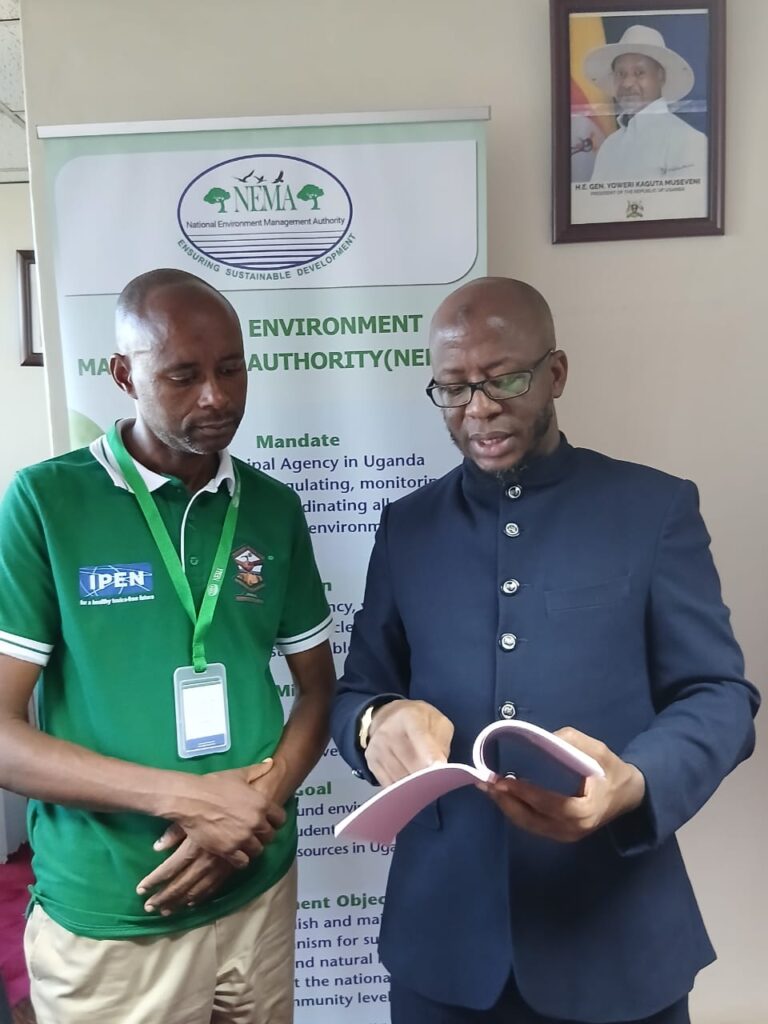
As Uganda joins the world for International Lead Poisoning Prevention Week, the head of NEMA says the country’s rules on lead paint are strong. The hard part, he admits, is catching the people who break them.
KAMPALA. “My eye cannot differentiate between 30 and 40 microns.”
Dr. Barirega Akankwasah, Executive Director of the National Environment Management Authority (NEMA), is talking about kaveera, the thin polythene bags Uganda has struggled for years to keep off the market. He could just as well be talking about the paint on the walls of your home, or your child’s classroom.
Paint with dangerous levels of lead looks, smells and sells much like paint without it. You cannot see the difference. Only a laboratory test can tell, and that, NEMA concedes, is where Uganda is falling short.
“In terms of the policy and regulatory framework, we have a robust framework that is very, very adequate,” Dr. Akankwasah told WEMECO. “What we need now is implementation, building our capacity for detection.”
His words could hardly be better timed. From 18 to 24 October 2026, the world marks the 14th International Lead Poisoning Prevention Week. The World Health Organization (WHO), which leads the campaign, has chosen the theme “From Detection to Prevention”. In Uganda, detection is exactly the missing piece.
The stakes are high. The Institute for Health Metrics Evaluation’s (IHME) latest data estimate that more than 3.5 million deaths globally were attributed to lead exposure in 2023, primarily due to cardiovascular effects. Additionally, lead exposure was estimated to account for more than 71 million years lost to disability (disability-adjusted life years, or DALYs) worldwide in 2023, and WHO says no level of exposure is known to be safe.
Four layers of law
Ask Dr. Akankwasah whether Uganda needs new laws on lead and he starts at the very top, with the Constitution. Article 39 gives every Ugandan the right to a clean and healthy environment, and government must protect it. Article 17 makes keeping that environment clean the duty of every citizen.
Below the Constitution sits the National Environment Act, Cap. 181, which he describes as “very elaborate” on how hazardous chemicals, lead among them, are imported, made, traded and moved.
The newest layer is the National Environment (Chemicals) Regulations, 2024. They follow a chemical “from when it gets into the country until it is disposed of”, and they list lead by name. Two years after they came in, NEMA says it is “still popularising” them. In other words, many of the people they apply to may not yet know they exist.
The final layer is a product standard. In November 2021, the Uganda National Bureau of Standards (UNBS) amended six paint standards to adopt the limit WHO recommends: no more than 90 parts per million (ppm) of lead. Around the world, the number of countries with legally binding controls on lead paint rose from 52 in 2012 to 93 in 2023, according to the UN Environment Programme (UNEP).
From the wall to the dinner plate
Lead does not stay where it is painted. As walls age, paint chips and turns to dust. Rain washes it into soil and water. From there, Dr. Akankwasah says, it climbs back up to us.
“When we allow leakage, it will contaminate our soils, it will contaminate our water systems, enter the food chain and come back to us human beings,” he said. Lead builds up in living things over time, he added, and fish from contaminated rivers and lakes carry it to our tables.
NEMA is not out to ban lead altogether. The metal still has legitimate uses, and the regulator’s aim is to contain it where it is needed. Paint is where that containment breaks down most. “The biggest source of leakage is actually paint,” he said, which is why he calls campaigns against lead paint “a good start”.
For some everyday products, though, he sees no reason for lead at all. “Why should we even have lead in some of the commonly used items where there is continuous exposure, like cosmetics? Why should we not get alternatives?”
He believes the alternatives will come, as they did for mercury. “When mercury was being banned, we started seeing alternatives showing up, including in mining,” he recalled. “I am sure science can give us lead-free paints. And on the market, if I may tell you, we already have lead-free paints.”
Many hands, one problem
NEMA sits at the top of Uganda’s environmental system as supervisor, coordinator and regulator. But no single agency can keep lead out of people’s homes, and Dr. Akankwasah is the first to say so.
UNBS sets the standards that paint must meet. The Uganda Manufacturers Association works with NEMA to encourage the industry to police itself. The Ministry of Gender, Labour and Social Development looks after the health and safety of the workers who make paint and those who spend their days brushing it onto walls. Once lead escapes, the Ministry of Water and Environment, the Ministry of Agriculture and consumer protection bodies are all drawn in.
“Once lead has leaked into the environment, we literally need the cooperation of everybody,” he said.
His biggest hope lies with the young. “The best entry point to prepare a generation yet to come is through young people,” he said, calling for schools to teach children about the dangers of lead and the safer choices available.
He also raised a source few Ugandans think about: ammunition. Europe has restricted lead shot for hunting, he noted, and the defence and security sector can be a source of lead in the environment. Has Uganda’s security sector moved to lead-free alternatives? He was candid. “I’m not a security expert. We can find out.”
Tough penalties, untested
On paper, breaking the rules on lead could cost you dearly. Dr. Akankwasah said some offences under the National Environment Act carry up to 15 years in jail and a fine of up to ten billion shillings.
For paint, the main lever is the Environmental and Social Impact Assessment (ESIA) certificate that NEMA issues for development projects. Every certificate, he said, carries a condition that paint used must not exceed 90 ppm of lead. Breach it and those penalties apply.
Burning waste that contains lead or other hazardous materials in the open air is also a crime, he added. Such waste must go to an incinerator that traps the toxic releases.
“The offences are there, and they are very, very heavy, extremely heavy,” he said, “because of the danger to life and the danger to the environment.”
What the interview did not reveal is whether anyone has ever faced these penalties over lead paint. NEMA offered no figures on inspections, prosecutions or fines. A law that has never been used is a warning, not yet a deterrent.
The detection gap
This brings us back to the bag. The law allows polythene carrier bags of 30 microns or thicker and bans anything thinner. But no inspector can tell the difference by eye. They must take the bag to a laboratory, wait for the result and come back, and by then, as Dr. Akankwasah put it, the offender is hardly going to be “still waiting for me to arrest you”.
Lead paint poses the same puzzle. “How do we detect that somebody has gone beyond the 90 parts per million? We need the capacity,” he said. What he describes is simple: pick a sample, test it, get a quick result, enforce. Doing it at scale is not.
His answer is to stop bad paint at the factory gate. “Once things have already gone into the market, it may be difficult,” he said. But UNBS cannot stand over every production line. It relies on sampling, and he admits that contraband can slip through.
The risk is real. In November 2025, UNBS seized about 4,964 litres of counterfeit and substandard paint at Naiga Complex in downtown Kampala. Officials said six certified brands were being faked. “Any paint with lead content above the allowed limit is hazardous and must not be sold,” UNBS spokesperson Sylvia Kirabo said at the time. Counterfeit paint like that bypasses factory quality checks entirely.
NEMA says help is on the way. Its new Environment Protection Force passed out its first cohort from Kabalye Police Training School in September. “There are still very few, but we’ve started,” Dr. Akankwasah said. “We have inspectors, still a few, but we are moving.”
What he did not say is whether paint can be tested for lead in Uganda today, by whom, or how fast. Those answers will decide whether the 90 ppm limit protects anyone.
One law, not many
Should Uganda pass a law just for lead? When WEMECO put the question to him, Dr. Akankwasah said no.
Lead is already named in the 2024 Chemicals Regulations, he argues, and separate laws for mercury, lead, chlorine and copper would bring “too much proliferation of laws”. The way heavy metals leak, and the way they are prevented and controlled, are often similar, so one general law serves them better.
“As long as a matter is specifically legislated, in other words you can enforce against it, then the law has done its part,” he said.
The question, then, is whether the regulators will do theirs. He insists they will. “It’s our duty to ensure that Ugandans are protected from lead poisoning and from lead pollution,” he said, adding that factory workers, and even the makers of lead-contaminated products, can become its victims. “It’s not just NEMA alone, but we will do our best to coordinate, monitor, regulate and supervise, as required of us by law. Our commitment is not doubtable.”
The price of safety
In the hardware shop, the cheaper tin is always tempting. Lead-free paint costs “slightly” more, Dr. Akankwasah said, mainly because its makers are not yet the majority on the market. Low public awareness does the rest.
“If I am selling paint with lead at a cheaper cost, people will go for the cheaper paint without looking at the long-term health and environmental impacts,” he said. “The decision is: how much do I save now?”
Some builders have already chosen differently. He knows of construction companies that, “without any ban or any law”, have decided to use only lead-free paint for the sake of sustainability. He would not name them, citing brand protection.
NEMA’s plan is what it calls a “just transition”: give manufacturers time and capital to change how they make paint, prepare buyers, then end lead paint after a fixed period. “The journey is on,” he said. “We haven’t reached where we must be.” He gave no date for the end of that journey.
For proof that a full switch can work, he points to the petrol pump. Uganda once sold leaded fuel. Today you cannot find it, because unleaded fuel became cheap enough to compete, and no motorist would now risk their engine.
“If you can worry about your engine, how about your life?” he asked. “With the car, at least you will lose the engine. But here we are losing you, the person.”
Then he put it in four words that every paint buyer in Uganda might keep in mind this week: “Life has no spare.”
What WEMECO will be watching
Under its Lead Paint Accountability in Uganda project, WEMECO is tracking whether Uganda’s lead paint rules are being enforced. These are the questions it will put to regulators:
- Testing: Can paint be tested for lead in Uganda today? Who does it, and how quickly do results come back?
- Market checks: Has UNBS sampled paint on sale against the 90 ppm limit, and how many samples failed?
- Enforcement: How many ESIA certificates have been checked for the lead paint condition? Has anyone been prosecuted or fined?
- Deadline: When will the “just transition” end, and lead paint leave the market for good?
- Awareness: Do paint makers, traders, painters and schools know about the 2024 Chemicals Regulations?
Lead paint in Uganda at a glance
| Item | Detail |
| Legal limit for lead in paint | 90 ppm, set by UNBS (paint standards amended November 2021) |
| Main laws | Constitution, Articles 17 and 39; National Environment Act, Cap. 181; National Environment (Chemicals) Regulations, 2024 |
| Maximum penalty cited by NEMA | Up to 15 years in jail; fine of up to ten billion shillings |
| Main enforcement tool | Lead paint condition in every ESIA certificate |
| New enforcement capacity | Environment Protection Force, first cohort passed out September 2026 |
| Global picture | 93 countries had legally binding lead paint controls in 2023, up from 52 in 2012 |
| Lead Poisoning Prevention Week 2026 | 18 to 24 October, theme “From Detection to Prevention” |
Peter Akugizibwe Araali is the Executive Director of WEMECO. This report draws on WEMECO’s interview with NEMA’s Executive Director, recorded on 13 October 2026.
Sources
- WEMECO interview with Dr. Barirega Akankwasah, Executive Director, NEMA, 13 October 2026
- International Lead Poisoning Prevention Week 2026, WHO
- International Lead Poisoning Prevention Week 2026, UNEP
- Almost 1 million people die every year due to lead poisoning, WHO (2022)
- After decades of use, paint makers cut ties with lead, UNEP (2023)
- Lead-based paints are a health threat, Daily Monitor (2022)
UNBS seizes 5,000 litres of fake paint in downtown Kampala, Pulse Uganda (2025)